Studying theory alone is not enough, it is equally important to learn how to apply this knowledge in practical, real-world scenarios. That is precisely why students are assigned various practicals in the first semester of the B. Pharmacy curriculum.Therefore, in this article, we will explore the B pharmacy first semester practicals and examine what exactly needs to be done in each, and provide information with simple examples.
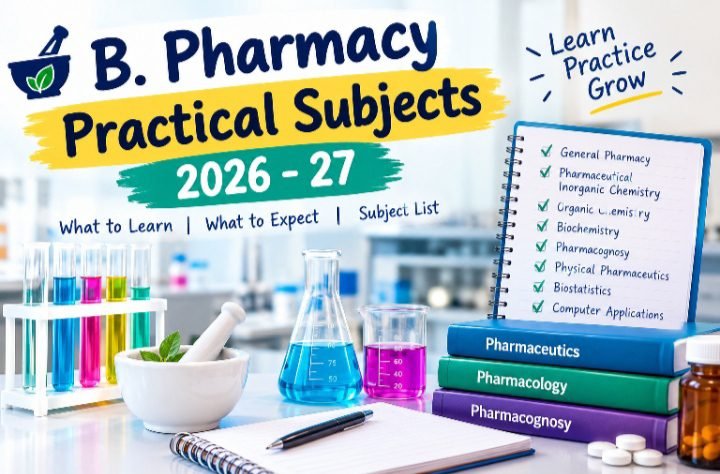
B. Pharmacy first semester practical
General pharmacy
In the practical sessions for this subject, students learn how to determine the appropriate dosage and concentration when preparing medicines. They are also taught how to formulate various types of medicinal preparations, including which ingredients to use, what additives are used to ensure stability, and guidance on selecting the most suitable form of medication to prepare.Various practical aspects of how to ensure the quality of medicines and how to label them, in accordance with the applicable requirements of standards such as the Indian Pharmacopoeia, the British Pharmacopoeia, and the World Health Organization.
1 Pharmaceutical Calculations -Determining the proportions of water and medicinal substances to achieve the correct concentration of a medication.
2 Solutions -Preparing a solution of potassium permanganate by dissolving it in water.
3 Syrups -Making syrups medicated, viscous (thick) liquid formulations used for conditions such as a cough.
4 Powders & Granules -Preparing coarse powders from medicinal substances, or creating granules by drying and processing medicinal plants.
5 Suppositories -Formulating suppositories (medicated inserts) for the proper administration of medicinal substances into the rectal or vaginal passages.
6 Semisolids -Making semi-solid formulations such as ointments to be applied to wounds or other affected areas of the body.
Healthcare Psychology and Communication Skills
In this, students will learn how to communicate effectively with patients, doctors, and the public in a clear and simple manner, using effective communication skills in a way that they can understand, through role plays, simulations, and reflective practice.Also through practical sessions in this subject, students learn about communication as a tool for learning, peer feedback, and communication-based tasks. They are taught to understand that each patient has a unique way of thinking and behaving which may vary depending on the situation and how to communicate with them appropriately. Additionally, students learn how to confidently explain health-related information to the general public.
1 Role-Play Simulations -Conducting a short role-play to explain to patients how to take their medication, including the timing and dosage.
2 Case Study Discussions -Analyzing a case involving a rare or complex medical condition through group discussion to explore its various aspects.
3 Peer-to-Peer Practice Sessions -Exchanging knowledge and insights on various topics through discussions with colleagues.
4 Community Engagement Tasks -Carrying out various tasks designed to foster maximum public participation and collaborative work.
5 Journaling and Self-Reflection Logs -Maintaining a record of personal changes and unique or noteworthy experiences.
Human Anatomy, Physiology and Pathophysiology I
In B. Pharmacy first semester practical of this subject Students are taught various topics, including Homeostasis, mechanisms used to combat pathogens (like bacteria and viruses), toxic substances, and other disease-causing agents when an illness occurs, diseases and their symptoms that arise from changes in the structure of organs. They also learn to use microscopes and gain an understanding of concepts through practical demonstrations covering microscopic structures, coordinated functioning, and gross morphology.
1 Study of Compound Microscopes –Observing various structures such as the internal components of a leaf using a compound microscope.
2 Microscopic Study of Tissues –Preparing slides to examine the structure of muscle and nerve tissues under a microscope.
3 Identification of Axial and Appendicular Bones -Identifying the bones of the limbs, the shoulder girdle, and the pelvic girdle, and understanding their classification as part of the appendicular skeleton.
4 Introduction to Hemocytometry –Conducting an experiment to measure the red blood cells (RBCs) and white blood cells (WBCs) in the blood.
5 Blood Count, Bleeding Time, and Clotting Time -Conducting experiments to count blood components, as well as to determine bleeding time and clotting time observing how these values are measured.
Introduction to Pharmacognosy
The practical work in this subject includes studying the color, odor, and microscopic structures of medicinal plant leaves, learning how to identify these plants, examining their constituents once they have acquired medicinal properties using microscopy, and conducting various tests to determine the purity of medicinal substances, including the detection of any extraneous or unwanted materials. For ensuring superior quality, practical knowledge is also provided regarding standardized quality control, the identification of plants, and the preparation of ‘voucher specimens’ samples preserved for the purpose of conducting various scientific studies.
1 Morphological Study of Plants -Observing the external structure (morphology) of plants such as Brahmi and Jatamansi.
2 Evaluation and Powder Microscopy of Crude Drugs -Evaluating the quality of Amla and Turmeric powders by examining their color, odor, texture, and microscopic structure.
3 Determination of Moisture Content, Swelling Index, and Foaming Index -Determining the moisture content and other properties of crude drugs.For moisture content, the level of moisture in Ashwagandha roots is measured; for the swelling index, the increase in the size of flax seeds (linseeds) upon soaking in water is measured.For the foaming index, the amount of foam produced by Nirgundi leaves is measured.
4 Measurement of Calcium Oxalate Crystals, Phloem Fibres, and Starch Grains -Conducting an experiment to examine the aforementioned components within a thin section (peel/layer) of plant material.
5 Experiential Learning and Medicinal Plant Collection -Visiting the college campus or a botanical garden to identify medicinal plants such as Tulsi (Holy Basil), Aloe vera, and Neem.
Pharmaceutical Inorganic and Analytical Chemistry
This subject includes practical training in volumetric analysis covering standard solutions, indicators, end points, equivalence points, and the use of laboratory apparatus such as burettes and pipettes. It also encompasses the preparation of inorganic compounds (used in pharmaceutical manufacturing) following specific laboratory procedures, as well as qualitative and quantitative analysis, and ‘limit tests’ for the identification of impurities.
1 Limit Tests -Checking the level of sulfate impurities in a pharmaceutical substance to determine whether it falls within the prescribed limits.
2 Preparation of Inorganic Pharmaceuticals -Synthesizing inorganic pharmaceutical substances such as sodium bicarbonate and studying their properties.
3 Test for Purity -Testing to determine whether any adulterants are present in a medicinal substance.
4 Assay of Inorganic Compounds, Including Standardization of Titrant -Determining the precise concentration of a hydrochloric acid solution using a standardized titrant.
When you start B.Pharmacy practicals, everything feels a little different from what you have studied in theory. Wearing a lab coat, handling chemicals, measuring ingredients and writing observations may sound simple, but getting everything right takes practice. In Pharmacognosy, some crude drugs have a strong, distinctive smell that you might find unusual at first. Slowly, you start recognizing drugs by their smell, colour, texture and other features. It’s actually interesting when you begin to identify a sample without looking at its label.
Analytical Chemistry practicals can test your patience, especially during titration. You keep adding the solution drop by drop, waiting for that colour change at the endpoint. Sometimes, you add just one extra drop and the colour changes more than expected. Frustrating, right? Common mistakes include reading the burette incorrectly, adding the indicator in the wrong amount, forgetting units in calculations or not recording observations immediately. Instead of rushing to finish first, take your time and follow each step carefully.
Viva can feel a bit scary too, especially when the teacher asks a question you weren’t expecting. You may remember the procedure but get stuck when asked why a particular reagent or indicator is used. A useful tip is to understand the aim, principle, procedure and result of every experiment instead of memorising the steps blindly. Before leaving the lab, take a minute to review what you did and why you did it. And don’t worry too much if your first reading is incorrect or an experiment needs to be repeated. These things happen to students all the time. With every practical, you become more confident, handle instruments more carefully and start understanding how the concepts you learn in theory actually work in the laboratory.
FAQ
1 How many practical subjects are there in B. Pharmacy first semester ?
There are 5 practical subjects in the first semester of B. Pharmacy as per the Pharmacy Council of India (PCI) syllabus
2 What do students learn in Healthcare Psychology practicals ?
Healthcare Psychology practicals help students develop communication skills through role-play simulations, case study discussions, peer-to-peer practice, community engagement, and self-reflection activities.
3 What is the difference between theory and practicals in B. Pharmacy ?
Theory teaches the concepts behind pharmaceutical sciences, while practicals allow students to apply those concepts through laboratory experiments observations, calculations, and demonstrations.
4 What are the important Human Anatomy practicals in B. Pharmacy ?
Human Anatomy practicals may include studying compound microscopes, observing tissue slides, identifying bones, and performing blood-related experiments.
5 Is a practical journal compulsory in B. Pharmacy ?
Practical journals or laboratory records are commonly required, but the exact submission and assessment rules depend on the university and college.