Tag: B Pharmacy Subjects List

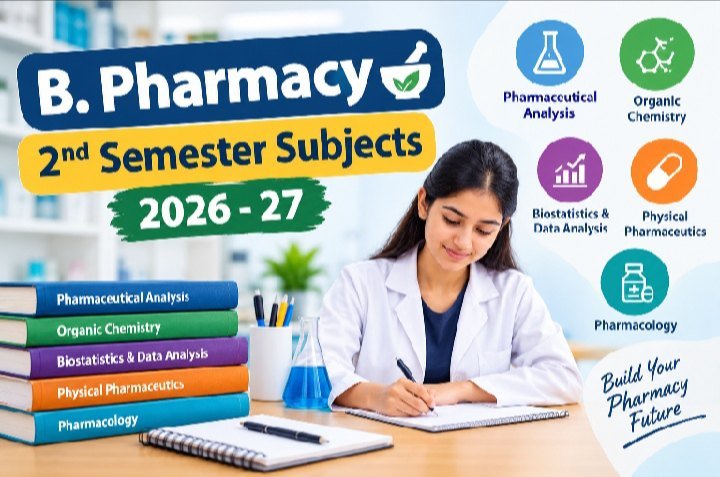
  • B pharmacy second semester subjects 2026-27

    B pharmacy second semester subjects 2026-27

    In b pharmacy second semester subjects, students will explore a range of new subjects,and various other topics essential to the field of pharmacy. In this article, we will look at an introductory overview of each B Pharm 2nd semester theory subject, as well as the units and topics contained within them.

    B pharmacy second semester subjects

    Subject NameCourse codeCredit Session Exam MarksEnd Exam MarksTotal
    Applied Biostatistics and Data Analytics for
    Pharmaceutical Sciences
    BP201T2203050
    BiochemistryBP202T3304575
    Human Anatomy, Physiology and Pathophysiology IIBP203T44060100
    Pharmaceutical Organic ChemistryBP204T44060100
    Pharmacognosy and PhytochemistryBP205T44060100
    Physical PharmaceuticsBP206T3304575

    Applied Biostatistics and Data Analytics for Pharmaceutical Sciences

    Biostatistics represents the intersection of biological phenomena and statistics. Having accurate experimental data from the experiment itself to the final conclusions is crucial for future scientific research, as it helps identify errors and shortcomings. In the field of pharmaceutical sciences, you will apply this type of data analysis. Furthermore, you will learn about concepts within statistics, such as probability, sampling, hypothesis testing, and the handling of various datasets.

    For Example: A pharmaceutical researcher tests two tablet formulations to compare their drug release. By collecting experimental data and applying statistical methods such as hypothesis testing, the researcher determines whether the difference in drug release between the two formulations is statistically significant.

    Unit NoTopics
    1Descriptive Statistic
    2Probability & Statistical Distributions in Healthcare
    3Sampling & Statistical Inference
    4Basics of Correlation & Regression
    5Statistical Analysis Using Python – Case based learning

    Biochemistry

    As the name of this subject suggests, our body is composed of various building blocks such as carbohydrates, proteins, fats, and nucleic acids. Within the body, a continuous series of metabolic processes takes place, which are fundamental to the development and structure of the body. These processes are facilitated by various enzymes. In this course, you will explore these mechanisms by studying concepts such as enzymology, biochemical metabolism, bioenergetics, and biological oxidation.

    For Example when a person consumes proteins, enzyme break proteins into amino acids. These amino acids are used by the body for tissue growth and repair, demonstrating the role of enzymes and protein metabolism in maintaining body functions.

    Unit NoTopics
    1Enzymology
    2Introduction about biomolecules
    3Lipid metabolism
    4Amino acids and protein metabolism
    5Nucleic acid metabolism and genetic information transfer

    Human Anatomy, Physiology and Pathophysiology II

    You will now study the continuation of the subject covered in the first semester, which focuses on various body systems. The human body is structured around several key systems. In this course, you will gain the fundamental knowledge required to understand the disease conditions affecting these systems, as well as the principles for planning rational pharmacological treatments.

    For Example: In this subject, students learn how asthma affects the respiratory system and how medicines such as bronchodilators help relax the airway muscles, making breathing easier. This connects human physiology, disease conditions, and pharmacological treatment.

    Unit NoTopics
    1Nervous System
    2Gastrointestinal System
    3Respiratory System, Urinary System
    4Endocrine System
    5Reproductive System and Cancer

    Pharmaceutical Organic Chemistry

    Organic Chemistry holds special significance in the B. Pharmacy second semester subjects. It is essential for understanding the chemical structure of drugs, the properties of organic compounds used in pharmaceutical manufacturing, and the various reactions involved in drug synthesis.

    In this b pharmacy second semester subject, you will learn about organic compounds used in pharmaceuticals including saturated hydrocarbons, alkyl halides, and aromatic hydrocarbons as well as their associated chemical reactions, reaction mechanisms, chemical structures, properties, methods of evaluation, and their overall relationship to drugs.

    For Example: Paracetamol is a medication used to reduce fever and alleviate pain. Understanding its chemical structure, the functional groups present within it, and the chemical reactions involved in its synthesis requires a knowledge of organic chemistry.

    Unit NoTopics
    1Aliphatic Saturated Hydrocarbons – Alkanes, Cycloalkanes
    2Aliphatic Unsaturated Hydrocarbons – Alkenes, Conjugated Dienes
    3Alkyl Halides
    4Benzene and Its Derivatives
    5Carbonyl Compounds -Aldehydes and Ketones

    Pharmacognosy and Phytochemistry

    In this subject, you are required to study the pharmacognostic features of primary and secondary medicinal substances. Under primary substances, you will examine carbohydrates, proteins, enzymes, and lipids; under secondary substances, you will study alkaloids, glycosides, volatile oils, resins, and tannins.

    This b pharmacy second semester subject covers the proper isolation of plants and plant-derived substances, their identification, the assessment and evaluation of their properties, and an understanding of the various technologies and techniques used for their extraction. You will also find explanations regarding the qualitative and quantitative analysis of plant materials.

    For Example: Quinine is an alkaloid obtained from cinchona bark. In pharmacognosy and phytochemistry, students learn how to identify medicinal plant materials, extract their active constituents, and analyze their quality and quantity.

    Unit NoTopics
    1Metabolic Pathways and Biogenetic Studies
    2Primary Metabolites
    3Secondary Metabolites
    4Extraction Methods for Medicinal Plants Conventional Methods of Extraction
    5Overview of Isolation, Identification and Characterization Techniques

    Physical Pharmaceutics

    To develop various dosage forms of medicines, it is essential to have a comprehensive understanding of concepts such as solubility, dissolution, interfacial phenomena, rheology, and micromeritics including the rheological and micromeritic properties of powders and dispersed systems.

    Furthermore, in this subject the study of colloidal and coarse dispersions, suspensions, and emulsions, as well as the specific pharmaceutical processes and operational units required for the manufacturing of medicinal products.

    For Example: When preparing an oral suspension, a pharmacist studies the particle size, viscosity, and stability of the formulation to ensure that the medicine remains evenly distributed and can be measured and administered accurately. This demonstrates the application of physical pharmaceutics in dosage-form development.

    Unit NoTopics
    1Solubility distribution phenomenon & buffers
    2Interfacial phenomenon
    3Colloidal and Coarse Dispersion
    4Rheological studies
    5Micromeritics

    FAQ

    1 What is the course code of biochemistry ?

    The course code for biochemistry is BP202T

    2 What topics are covered in Pharmaceutical Organic Chemistry ?

    In Pharmaceutical Organic Chemistry, you will study the structures, properties, and chemical reactions of organic compounds relevant to pharmaceutical sciences.

    3 What is the total number of marks for the subject Physical Pharmaceutics ?

    The subject Physical Pharmaceutics has a total of 75 marks.

    4 What is Pharmacognosy and Phytochemistry in B. Pharmacy ?

    In this, you will carry out the isolation, extraction, and analysis of plant substances, including both primary and secondary medicinal compounds.

    5 What is the role of Pharmacognosy in drug development ?

    Pharmacognosy helps identify and evaluate medicinal substances obtained from natural sources.
  • B. Pharmacy first year subjects 2026- 27

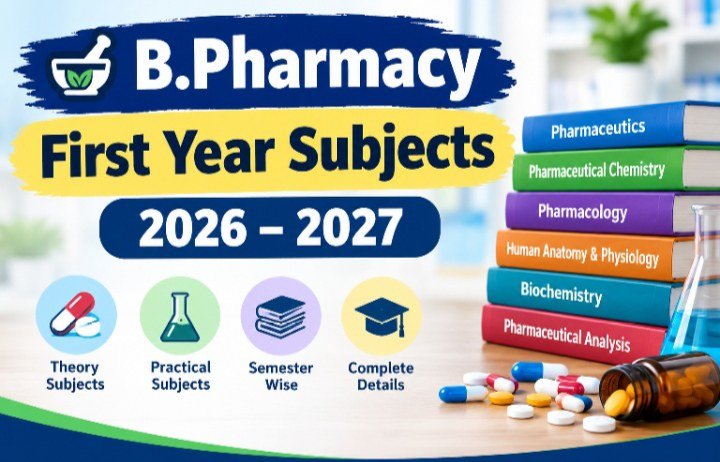
    B. Pharmacy first year subjects 2026- 27

    B. Pharmacy first year subjects are divided into two semesters, with the first semester comprising six theoretical and six practical subjects. There may be slight variations in these subjects depending on the university, as each institution follows its own specific curriculum and operational framework. In this article, we will look at the six theoretical subjects of the first semester in detail with names of their units and topics.

    B. Pharmacy first year subjects

    Basics of Python Programming for Pharmaceutical Sciences

    In this era of technology, this subject introduced into the curriculum starting this year is multifaceted. It encompasses teaching students various programming skills through the use of data structures, functions, and control structures. Furthermore, it introduces students to healthcare-related datasets and their analysis, utilizing data analysis tools such as NumPy and Pandas, as well as the visual representation of pharmaceutical data through graphical tools.

    For example, a student can use Python and Pandas to organize a dataset containing medicine names, batch numbers, and laboratory test results. The student can then calculate average values, identify missing data, and create graphs to compare results.

    Unit NoTopics
    1Introduction to Python programming
    2Control Structures & Functions
    3Data Structures & File Handling
    4Data Handling with Pandas
    5Data Visualization with Matplotlib

    General Pharmacy

    Everything has a history; in this subject, you will study the history of pharmacy as well as its evolution.

    Dosage forms are the physical forms in which medicines are prepared for administration. Tablets and capsules are common solid dosage forms, while syrups and solutions are liquid preparations. Ointments are semi-solid preparations generally applied to the skin. Students learn how dosage forms are formulated, the roles of active pharmaceutical ingredients (APIs) and excipients, and why the selection of ingredients affects the stability, quality, and administration of a medicine.”

    The ‘active pharmaceutical ingredient’ (the component responsible for the desired therapeutic effect) For example, paracetamol is the API in many medicines used to relieve pain and reduce fever, and ‘excipients’ (substances that support the active ingredient, such as those used to give a tablet its shape or structure). For example, binders help hold tablet ingredients together, preservatives help prevent microbial growth in suitable formulations, and certain excipients improve taste, appearance, flow properties, or the release of the active ingredient.

    Unit NoTopics
    1Introduction to the Profession of Pharmacy
    2Pharmaceutical Calculations
    3Solid Dosage Forms
    4Monophasic and Biphasic Liquids
    5Semisolid Dosage Forms

    Healthcare Psychology and Communication Skills

    This b pharmacy first year subject describes the various psychological reactions that arise during illness, as well as how an individual behaves when ill; it covers different facets of personality, the various stages of human development, and an individual’s behavior during both periods of illness and health.

    The field of pharmacy is vast. Roles such as medical representative, pharmacist, and various positions within the pharmaceutical industry require a strong emphasis on communication skills. Since success in these roles often depends on one’s ability to articulate ideas effectively, the curriculum in this field integrates various aspects related to these essential skills.

    For example, a pharmacist may need to explain when and how a prescribed medicine should be taken, clarify instructions provided by the prescriber, or guide a patient to consult a doctor when further medical advice is required.

    Unit NoTopics
    1Introduction to Psychology in Healthcare
    2Developmental and Behavioural Psychology
    3Foundations of Health Communication
    4Professional Communication in Healthcare Settings
    5Health Psychology and Behavioural Interventions

    Human Anatomy, Physiology, and Pathophysiology I

    The structure of the human body is highly unique. This subject provides an in-depth understanding of that structure, including the fundamental principles upon which it is built, as well as any abnormalities or irregularities that may occur at a structural level. Through this course, you will learn about the various organs and parts of the body, and the factors that contribute to their balance or imbalance.

    In pathophysiology, you will also study the specific sequence of events that lead to the development of a disease. The progression from exposure to harmful agents to their subsequent impact on the body involves a series of processes and distinct stages that contribute to the onset of a disease; you will examine these various stages and the events that occur during this process.

    For example The human heart is an important organ that pumps blood throughout the body. In anatomy, students learn about the structure of the heart, including its chambers, valves, and major blood vessels.

    In physiology, they study how the heart pumps blood and maintains blood circulation to supply oxygen and nutrients to different organs.Pathophysiology focuses on how normal body functions change during a disease.

    Unit NoTopics
    1Introduction to human body, Basic principles of cell injury and adaptation
    2Integumentary system and wound healing, Skeletal system and joints, Diseases of bones and joints
    3Body fluids, blood and lymphatic system,Basic mechanism of inflammation and repair, Haematological diseases
    4Peripheral nervous system, Special senses
    5Cardiovascular system

    Introduction to Pharmacognosy

    Medicinal preparations are derived from plant-based constituents. This field encompasses the cultivation and conservation of medicinal plants; a comprehensive understanding of the quality, purity, and properties of these medicinal substances; the study of their physiological action at a microscopic level and their primary and secondary metabolites; and the quality assessment of raw materials using parameters such as organoleptic, microscopic, and chemical analysis. Furthermore, it integrates long-standing traditional medical practices and plant-based therapeutic agents.

    For example Neem is a medicinal plant Its leaves, bark, seeds, and other plant parts have been used in traditional medicinal preparations. The cultivation and conservation of neem help maintain the availability of this natural resource. After collection and drying, suitable plant parts may be used as crude drugs. Their identity and quality can be evaluated through organoleptic examination, microscopic observation, and chemical analysis.

    Unit NoTopics
    1Fundamentals of Pharmacognosy
    2Cultivation, Collection, Processing and Storage of Drugs of Natural Origin
    3Quality Control of Drugs of Natural Origin (WHO Guidelines)
    4Introduction to Metabolites of Plant Origin
    5Phyto-therapeutic Agents

    Pharmaceutical Inorganic and Analytical Chemistry

    The efficacy of medicinal substances depends upon their purity;adulteration can affect quality, safety, identity, or efficacy in different ways.In the field of pharmaceutical manufacturing, purity holds paramount importance, which is precisely why this b pharmacy first year subject has been included in the curriculum,containing various concepts.

    Buffer systems for maintaining pH; For example, a suitable buffer system can help maintain the required pH of a pharmaceutical formulation, supporting its stability and performance, Titration used to determine the concentration of an unknown substance or the strength of a solution and its various types; For example, in an acid–base titration, a solution of known concentration is gradually added to an unknown acid solution until the reaction reaches its endpoint. This helps calculate the concentration of the acid. Gastrointestinal agents, including the various components involved in the digestive process and the substances that act upon them.For exampleAntacids used to neutralize excess stomach acid, along with their properties, uses, and quality evaluation, are described in this.

    Analytical chemistry plays an important role in evaluating the identity, purity, strength, and quality of pharmaceutical substances. It involves the use of different laboratory methods to examine raw materials and pharmaceutical products to ensure that they meet the required standards.

    Unit NoTopics
    1Introduction to pharmaceutical analysis
    2Acid-Base Chemistry and Buffer Systems in Pharmacy,Major extra and intracellular electrolytes
    3Acid base titrations, Non-aqueous titrations, Precipitation titrations and gravimetry, Redox titrations
    4Gastrointestinal agents, Radiopharmaceuticals
    5Miscellaneous Compounds

    Source and syllabus note:

    B pharmacy first year subject names and unit details in this article are based on the applicable Pharmacy Council of India (PCI) syllabus document. Students should consult the official PCI website and their university’s latest curriculum or examination guidelines to confirm the syllabus, subject codes, credits, and marks applicable to their academic year.

    FAQ

    1 How many theory subjects are there in the first semester of B. Pharmacy?

    There are six theory subjects in the first semester of B. Pharmacy.

    2 Where can I find the list of subjects for the first year of B. Pharmacy?

    The list of subjects is available on the official PCI website.

    3 What are the theory subjects in the first semester of B. Pharmacy?

    Theory Subjects in first semester of b pharmacy are Basics of Python Programming for Pharmaceutical Sciences, General Pharmacy, Healthcare Psychology and Communication Skills, Human Anatomy, Physiology, and Pathophysiology I, Introduction to Pharmacognosy, and Pharmaceutical Inorganic and Analytical Chemistry.

    4 Do B. Pharmacy first-year subjects vary between universities?

    The subjects for the B. Pharmacy First year may vary depending on the university; therefore, students should check with their respective institution and visit the PCI (Pharmacy Council of India) website regularly for the latest updates.

    5 Has the first-year Pharmacy syllabus changed starting from 2026?

    Yes, the first-year syllabus has changed starting this year; the curriculum is aligned with the National Education Policy (NEP) 2020.